
Battery safety should be assessed as a system-level procurement issue, not as a single battery-specification question. For eVTOL buyers, the relevant risks include how a cell failure begins, whether it can spread through a pack, how the aircraft detects it, what happens during charging or a hard landing, and whether the operator can maintain the system without creating new hazards.
A battery with strong energy density may support payload or range targets, but that benefit means little if thermal events, degraded cells, charging constraints, or emergency procedures make the aircraft difficult to dispatch reliably. The most useful comparison is therefore not “which battery is best?” It is “which battery architecture, operational model, and safety evidence fit the intended mission?”
Start with thermal runaway, but do not stop there
Thermal runaway is the battery risk most people recognize. It occurs when a cell generates heat faster than it can reject it, potentially causing a self-accelerating failure that can release heat, smoke, flammable gases, and debris. In an eVTOL, the concern is larger than the failed cell itself. Buyers need to understand whether a failure remains localized or can propagate to neighboring cells, modules, wiring, aircraft structure, and occupied areas.
Two aircraft may both use lithium-based batteries yet present very different risk profiles. One may isolate cells with physical barriers, thermal spacing, vent paths, and module-level monitoring. Another may rely more heavily on a compact, high-energy package with less separation between cells. Neither layout can be judged from a chemistry label alone. Buyers should ask for a clear explanation of the propagation-control strategy and the conditions under which it is expected to work.
The central question is not whether thermal runaway is “impossible.” A credible design assumes that cells can fail and shows how the aircraft prevents one failure from becoming a loss-of-aircraft event.
Compare the whole pack architecture, not the cell chemistry name
Buyers often focus on whether an aircraft uses a particular cell chemistry because chemistry influences energy density, heat behavior, charging characteristics, and cycle life. That is relevant, but it is only one layer of the decision. A well-integrated battery pack with conservative operating limits can be safer in service than a more energy-dense configuration pushed close to its thermal or electrical limits.
Ask how the manufacturer balances usable energy against reserve margins. A design with less headline energy but stronger margins for hot weather, aging, diversion, hover demand, and charging variation may suit repetitive commercial operations better. Conversely, a mission with relatively short sectors, controlled charging, and ample ground time may be able to accept a different balance between energy capacity and operational margin.
The comparison should also include pack segmentation. Multiple electrically and physically separated battery sections can improve fault isolation, but segmentation adds connections, monitoring points, contactors, and control logic. More segments are not automatically safer; they must be supported by robust controls and clear failure handling.
Battery management redundancy is a flight-safety question
The battery management system, or BMS, monitors cell and pack condition, estimates available energy, controls charging, and can command protective action when limits are exceeded. Its estimates affect decisions that are fundamental to flight: whether the aircraft can depart, how much reserve remains, whether power is available during a demanding phase, and whether a pack should be isolated.
When comparing eVTOL offerings, buyers should look beyond claims of “smart monitoring.” They should establish what the system measures, how rapidly it recognizes abnormal behavior, how it responds to missing or conflicting sensor data, and how its information reaches the aircraft’s flight-control and maintenance systems.
Redundancy deserves particular attention. A battery system may have duplicate sensors or controllers, but the buyer should understand whether those channels are independent enough to avoid a common failure. For example, duplicate measurements are less valuable if they share the same vulnerable wiring route, power source, cooling path, or software assumption. The aim is not simply redundancy on a component list. It is continued, trustworthy decision-making after a credible fault.
Energy estimation is equally important. A battery can be physically healthy while its available energy is uncertain because of temperature, age, prior use, or imbalance between cells. An aircraft intended for short, frequent sectors needs a dispatch policy that accounts for this uncertainty rather than treating a displayed state of charge as an exact fuel gauge.
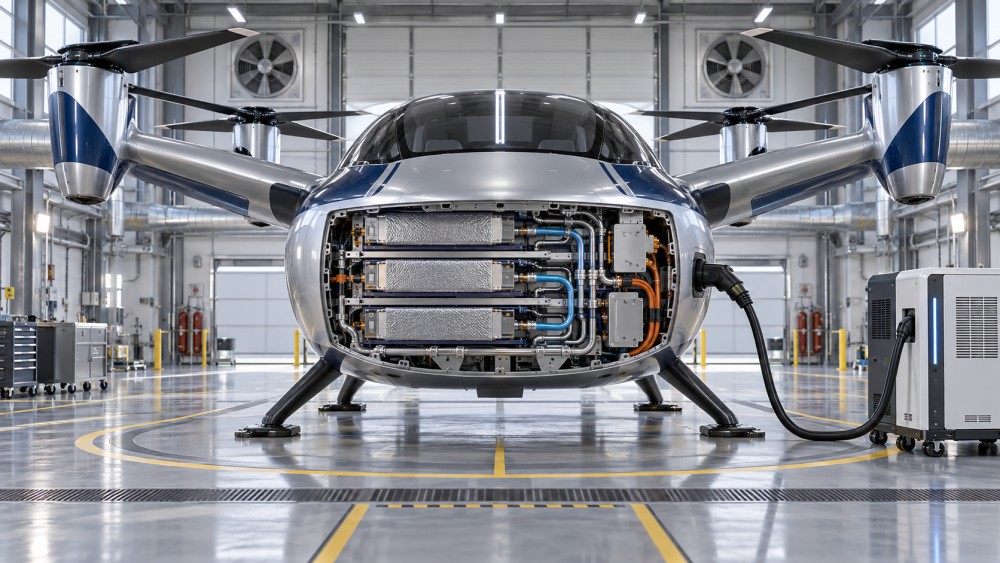
Charging is where fleet battery risk often becomes visible
An eVTOL battery is not used only in the air. It is repeatedly connected to ground equipment, exposed to turnaround pressure, and handled by operational staff. Charging compatibility, connector condition, cooling during charging, software communication, and site power quality can all influence safety and availability.
A buyer comparing aircraft should assess the charging ecosystem as carefully as the aircraft. Does the proposed charging method match the intended turn schedule? Is battery temperature managed before, during, and after charging? What happens when the charger and aircraft disagree on a fault state? Can a charging session be safely stopped, isolated, and investigated without disabling the wider operation?
Fast charging can be operationally attractive, particularly for high-utilization shuttle concepts, but it places greater emphasis on thermal control, cell condition monitoring, and disciplined turnaround procedures. A slower charging approach may impose scheduling limits while reducing stress in a given operating profile. The better choice depends on sector length, ambient conditions, reserve policy, fleet utilization, and access to spare batteries or alternate aircraft.
Buyers should also avoid treating charging infrastructure as a separate facilities purchase. The aircraft, charger, battery software, site emergency response, and maintenance process form one operational chain. A mismatch in any part can create dispatch disruption or a safety exposure.
Crash, hard-landing, and water-exposure scenarios need specific answers
Battery packs are vulnerable not only to internal defects but also to mechanical damage. A hard landing, runway excursion, ground collision, dropped removable pack, or maintenance impact can deform cells or damage high-voltage isolation without immediately producing obvious symptoms. A pack may remain electrically active after the event, which makes inspection and recovery procedures particularly important.
Compare how the aircraft protects its battery location within the airframe. Buyers should understand the load paths around the pack, the protective structure beneath it, the exposure of connectors and cooling lines, and the criteria that trigger removal from service after an abnormal landing. A generic statement that the battery is “protected” is not enough; the relevant question is protected against which foreseeable impact directions and operational events.
For operations near water, in humid coastal conditions, or on exposed vertiports, enclosure sealing and drainage also matter. Water does not need to enter a cell to cause trouble. Moisture or contaminants at connectors, sensors, cooling interfaces, and insulation paths can create faults that are intermittent and difficult to diagnose. The maintenance plan should address these conditions rather than assuming a clean, dry operating environment.
Containment must protect the aircraft, not merely the battery box
Battery containment is often described as a rugged enclosure. In practice, it is a coordinated design problem involving pressure relief, hot-gas routing, fire boundaries, wiring protection, cooling-system behavior, and the location of critical avionics or flight-control equipment.
A pack that vents away from passengers but toward control wiring, composite structure, propulsion electronics, or another battery compartment may still create an unacceptable aircraft-level hazard. Buyers should ask how a battery event interacts with the rest of the vehicle: Can smoke impair pilot visibility or sensors? Can heat damage a flight-control channel? Can vented gases accumulate in an enclosed volume? Can the system isolate high voltage while preserving enough power for controlled flight?
This is one reason battery selection cannot be separated from aircraft integration. Firms tracking eVTOL thermal management, airframe materials, and avionics redundancy, including aerospace intelligence sources such as AL-Strategic, can help procurement teams frame the right cross-disciplinary questions. The decision should be based on how these systems work together, rather than on isolated component claims.
Airworthiness evidence should be usable in a buyer’s evaluation
Buyers do not need to replicate a regulator’s technical review, but they should expect traceable safety evidence. Useful material explains the design assumptions, the important failure conditions considered, the validation approach, operating limits, and the procedures required when a fault occurs. Broad references to certification activity do not substitute for understanding the specific battery safety case.
It is reasonable to compare how openly each supplier addresses difficult issues: cell failure, sensor disagreement, cooling loss, contactor failure, damaged packs, charging faults, and degraded capacity. A mature program will not imply that every risk has disappeared. It will define detection, isolation, crew or automation response, maintenance action, and the boundaries within which the aircraft is intended to operate.
For a fleet buyer, the practical test is whether the safety case can be translated into dispatch rules, pilot or remote-operator procedures, ground-staff training, emergency planning, and maintenance instructions. If the operational consequences are unclear, the aircraft may be harder to deploy safely even if its technical concept is compelling.
Do not overlook aging, replacement, and data ownership
Battery risk changes over time. Capacity fades, resistance changes, cell imbalance can emerge, and repeated high-power use may affect packs differently from gentler duty cycles. A buyer should compare the manufacturer’s condition-monitoring approach and decide who owns the data needed to evaluate battery health across the fleet.
Replacement strategy matters as much as predicted service life. Is the pack fixed in the aircraft or designed for removal? What facilities, tooling, transport controls, training, and inspection steps are needed? How is a suspect pack stored and handled? A removable battery can support turnaround flexibility, but it also introduces handling and traceability risks. A fixed pack reduces ground movement but may lengthen maintenance downtime. The appropriate design depends on the planned operation.
Ask for a clear process for identifying a degrading pack before it becomes an in-service event. This should include the relationship between recorded flight loads, charging history, fault messages, inspection findings, and return-to-service decisions.
A practical comparison sequence for eVTOL buyers
Begin by defining the operation: sector length, hover and diversion exposure, turnaround time, climate, vertiport layout, daily utilization, and whether operations are passenger-facing, cargo-focused, or mixed. Battery safety cannot be judged independently of those conditions.
Then compare suppliers using a common set of questions:
- How is an individual cell failure detected, isolated, vented, and prevented from propagating?
- What independent monitoring and control paths remain available after a sensor, controller, or power fault?
- How do charging equipment, aircraft software, cooling, and ground procedures handle abnormal conditions?
- What inspection and quarantine actions follow a hard landing, overtemperature alert, charging interruption, or suspected impact?
- How does battery health affect dispatch, reserve planning, maintenance intervals, and replacement decisions?
- What evidence links the battery’s containment design to the aircraft’s structure, avionics, and flight-control architecture?
The strongest eVTOL battery proposition is rarely the one with the most dramatic standalone claim. It is the one whose limits, failure responses, maintenance burden, and charging requirements are understood well enough to support the intended operation day after day.