
Yes. eVTOL aircraft certification differs from conventional aircraft certification not because regulators have abandoned established airworthiness principles, but because the aircraft combines several certification domains that were previously assessed separately: fixed-wing flight, vertical lift, distributed electric propulsion, high-voltage energy storage, highly integrated software, and new operating concepts.
A conventional aircraft can generally be placed within a mature regulatory category. A transport airplane is evaluated primarily under a large-airplane certification basis; a light aircraft under a smaller-airplane basis; a helicopter under rotorcraft rules. An eVTOL may transition between hover and wing-borne flight, use multiple independent propulsors, rely on batteries rather than fuel tanks, and depend on automated control functions to remain controllable after component failures. Those characteristics do not eliminate traditional requirements for structural strength, controllability, lightning protection, fire safety, continued airworthiness, and safe operations. They do, however, change how compliance must be demonstrated.
The practical distinction is therefore less about whether eVTOLs are “certified more easily” or “certified under completely new rules.” The real issue is that certification authorities must establish an acceptable safety framework before they can judge a specific design against it.
Conventional aircraft usually begin with an established rulebook
For conventional aviation, aircraft configuration and certification category are closely aligned. In the United States, airplanes and rotorcraft are generally certificated under established airworthiness standards in Title 14 of the Code of Federal Regulations, such as Parts 23, 25, 27, and 29. In Europe, comparable certification specifications exist for normal-category airplanes, large airplanes, small rotorcraft, and large rotorcraft.
That does not make conventional certification simple. A new commercial jet, turbine helicopter, or composite airframe can still require extensive structural tests, flight-test campaigns, system safety analyses, environmental qualification, production controls, and continuing-airworthiness documentation. The difference is that the regulator and applicant can normally begin with a well-defined set of prescriptive requirements shaped by decades of operational evidence.
For example, the certification logic for a conventional twin-engine airplane already contains mature expectations for engine failure, fuel-system integrity, icing exposure, evacuation, bird strike, fatigue, and flight-crew workload. Manufacturers may use new materials or systems, but the basic configuration has a recognized regulatory foundation.
An eVTOL aircraft often has no single historical category that fully captures its architecture. It may resemble an airplane during cruise, a rotorcraft in vertical takeoff and landing, and a highly automated electric system throughout the mission. That gap is where the certification process becomes materially different.
eVTOL certification starts with classification and certification basis
The first challenge is determining which regulatory route is appropriate. In the United States, the Federal Aviation Administration has used its special-class authority under 14 CFR §21.17(b) for powered-lift aircraft that do not fit neatly within existing airplane or rotorcraft standards. The FAA’s approach has involved drawing from established airworthiness requirements while adding tailored criteria where conventional rules do not address a powered-lift design adequately.
In Europe, the European Union Aviation Safety Agency developed Special Condition VTOL as a dedicated framework for vertical takeoff and landing aircraft. Its purpose is not to create lower safety expectations for urban air mobility. It is to translate the fundamental objective of safe flight into requirements appropriate for aircraft that may have novel lift, propulsion, automation, and energy architectures.
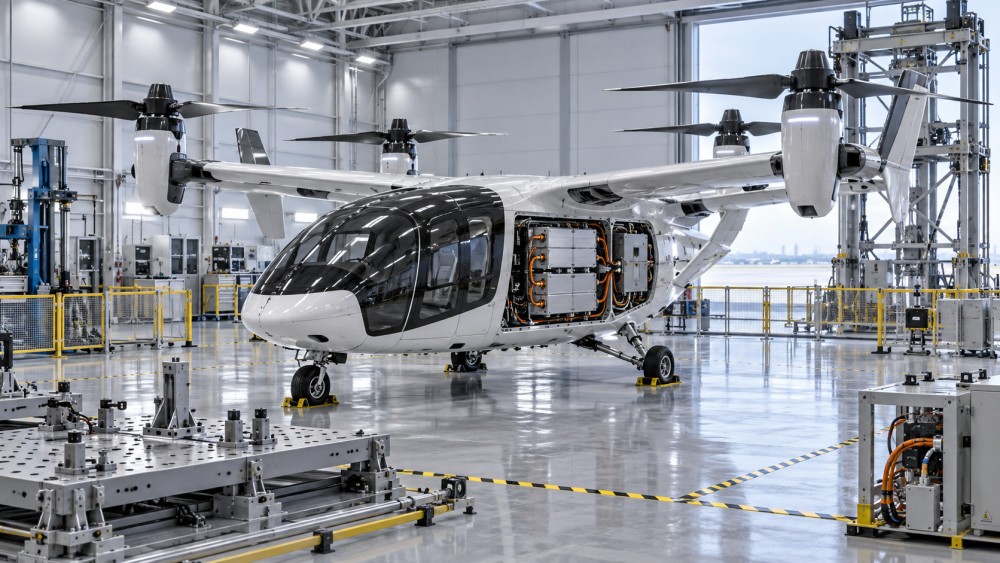
This distinction matters commercially. A conventional aircraft program can often estimate its certification work from prior programs in the same category. An eVTOL program must also resolve foundational questions with the authority: What is the aircraft’s intended category? Which failure conditions are acceptable? How should the transition phase be assessed? What performance margin is required after loss of a propulsor, battery segment, inverter, sensor, or flight-control channel?
The certification basis is therefore not merely a legal document. It determines engineering priorities, test requirements, supplier qualification obligations, documentation depth, and the amount of design flexibility remaining late in the program.
Vertical flight and transition create failure conditions that fixed-wing aircraft do not face in the same way
Conventional fixed-wing aircraft generate lift primarily through forward motion over wings. A helicopter generates lift through a main rotor, with established rules governing rotor drive systems, autorotation capability, rotor dynamics, and control response. eVTOL designs can use lift rotors, tilting propellers, tilting wings, ducted fans, lift-plus-cruise arrangements, or other distributed-propulsion layouts.
The critical certification question is not simply whether the aircraft can take off vertically. It is whether it can remain safely controllable through every relevant combination of speed, altitude, propulsion state, environmental condition, and equipment failure.
Transition flight is particularly important. During the shift from hover to forward flight, aerodynamic forces, thrust direction, control laws, and power demand can change rapidly. A design may have adequate hover performance and adequate cruise performance while still presenting complex controllability issues between those two states. Regulators need evidence that the aircraft remains stable, controllable, and predictable if a fault occurs during transition rather than only in ideal conditions.
Distributed propulsion complicates the analysis. Multiple propulsors can create useful redundancy, but redundancy is not automatic. Several motors may share a battery pack, power bus, cooling circuit, software controller, common mounting structure, or sensor set. A certification authority will examine common-cause failures: faults that can disable more than one supposedly independent channel at the same time.
For a conventional twin-engine airplane, the failure analysis is often centered on an engine-out condition and the aircraft’s ability to continue or land safely. For an eVTOL, the analysis may need to consider the location of each propulsor, the resulting asymmetric thrust, the available control authority, electrical isolation, thermal propagation, and the aircraft state at the moment of failure. Losing one motor in cruise may be manageable; losing a different motor during low-altitude hover could be substantially more severe.
Battery certification is an aircraft-level safety issue, not a component approval exercise
Electric propulsion is one of the most important differences between eVTOL and conventional aircraft certification. Aviation has long regulated electrical systems, but high-energy battery packs used as the principal propulsion energy source introduce a different set of hazards from conventional jet fuel or avgas systems.
Certification must address battery cell behavior, pack design, containment, cooling, electrical protection, state-of-charge estimation, charging procedures, thermal runaway, smoke and fire effects, and the possibility of propagation from one cell or module to another. The central question is whether a battery failure can remain contained long enough for the aircraft to complete a safe response.
This cannot be solved through laboratory battery testing alone. A battery that performs acceptably in a cell-level abuse test may behave differently when integrated into a tightly packaged aircraft installation exposed to vibration, altitude, temperature variation, electromagnetic interference, structural loads, and crash conditions. The installation must be assessed as part of the aircraft’s overall system safety architecture.
Energy reserve also requires a different operational logic. Conventional aircraft normally calculate reserves around fuel quantity, diversion capability, holding requirements, and predictable fuel consumption. eVTOL aircraft must account for battery degradation, power demand in hover, temperature effects, diversion options, landing-site availability, and the energy required to manage abnormal conditions. A short planned route does not necessarily imply a simple energy-reserve calculation, especially when vertical lift consumes a high share of the mission’s available energy.
Charging infrastructure is not normally part of the aircraft type certificate in the same way as the aircraft itself, but it can affect the safety case. Battery charging, high-voltage connectors, cooling interfaces, maintenance procedures, and data management all influence whether the aircraft can be turned around safely and consistently in service.
Software assurance is more central to the airworthiness case
Modern conventional aircraft already rely heavily on software. Fly-by-wire airliners, integrated avionics, engine controls, flight management systems, and electronic displays are all subject to rigorous development-assurance expectations. eVTOL aircraft extend that dependence because software may coordinate propulsion, lift distribution, stability augmentation, transition control, energy management, and automated contingency responses.
In many eVTOL configurations, a pilot cannot directly manage every motor, propeller, tilt mechanism, and electrical path in real time. The control system must translate pilot inputs into coordinated vehicle behavior. That makes the flight-control architecture part of the fundamental airworthiness argument rather than an optional performance enhancement.
Authorities will assess not only whether software performs its intended function, but also how the aircraft behaves when data are incorrect, sensors disagree, communications are interrupted, computing resources fail, or an update introduces an unintended interaction. The relevant issue is determinism under fault conditions. A system must fail in a manner that preserves a safe aircraft state, or provide the crew with sufficient control and information to manage the event.
Software changes also create a continued-airworthiness challenge. In conventional aircraft, changes to avionics software can require careful configuration control. In an eVTOL fleet with more tightly coupled digital systems, frequent revisions to battery management, flight-control logic, diagnostic tools, or cybersecurity protections can make configuration discipline even more consequential. Manufacturers must demonstrate that the certified design remains identifiable and that changes do not invalidate prior safety assumptions.
Traditional structural and environmental requirements still apply
A recurring misconception is that eVTOL certification is mostly about batteries and autonomous flight. In reality, the aircraft must still meet the physical demands applied to any airborne vehicle.
Structures must tolerate limit and ultimate loads, fatigue, vibration, impact threats, manufacturing variation, corrosion, and environmental exposure. Composite airframes require substantiation of material allowables, bonded-joint integrity, damage tolerance, inspection methods, and repair procedures. Propulsor blades, nacelles, tilt mechanisms, landing gear, fasteners, and high-voltage cable routing must all be evaluated for their own failure modes and interactions.
Distributed propulsion may introduce vibration patterns and acoustic loads that do not match those of a conventional engine installation. A failure of a rotating component can create blade-release or debris-containment concerns. High-voltage systems add arc-fault, insulation, electromagnetic compatibility, and lightning-protection considerations. These are not peripheral engineering details; each can affect the aircraft’s ability to sustain safe flight after a foreseeable fault.
The difference from conventional certification is often not the existence of these requirements, but the way they overlap. A structural design decision may affect battery cooling. A propulsion layout may alter crashworthiness. An avionics redesign may change the controllability analysis. eVTOL certification demands unusually strong integration across airframe, electrical, propulsion, software, and operational engineering teams.
Operational approval cannot be separated from aircraft certification
Type certification establishes that a design can meet applicable airworthiness standards. It does not by itself authorize commercial operation. Conventional aviation also separates aircraft certification from pilot licensing, operator approval, maintenance authorization, and air traffic integration. eVTOLs make those boundaries more visible because the proposed missions often involve dense metropolitan areas, constrained landing sites, frequent cycles, and unfamiliar passenger expectations.
The FAA’s powered-lift operational and pilot-certification rulemaking illustrates this connection. A powered-lift aircraft may require operating rules and pilot qualification concepts that differ from those used for either conventional airplanes or helicopters. Questions include transition training, automation management, emergency procedures, performance planning, and the operational limitations associated with a particular aircraft design.
For an eVTOL manufacturer, certification strategy must therefore account for the complete service model. An aircraft designed for short intercity or airport shuttle missions may face different operational assumptions from an aircraft intended for cargo transport, emergency response, or remote-area logistics. The same airframe can encounter very different certification and approval burdens depending on its operating environment, landing infrastructure, payload, dispatch model, and degree of automation.
Production conformity is a major differentiator for emerging suppliers
Certification is not achieved by proving that one prototype can fly safely. The applicant must show that production aircraft will conform to the approved design. This requirement is familiar in conventional aerospace, but it can be especially demanding for eVTOL programs that rely on new battery modules, electric motors, power electronics, composite assemblies, software-controlled subsystems, and suppliers from both aviation and automotive value chains.
Components that are technically advanced but produced under non-aerospace quality assumptions may not provide the traceability, change control, environmental qualification, or documentation needed for an aircraft program. A battery-cell supplier, inverter manufacturer, sensor producer, or composite fabricator can become a certification-critical part of the supply chain.
Procurement decisions therefore cannot be based solely on unit cost, laboratory performance, or quoted capacity. The relevant question is whether the supplier can support controlled configuration, material traceability, process validation, quality escapes investigation, long-term availability, and approved design changes. A technically suitable component can still create program risk if its manufacturing evidence is insufficient for the aircraft’s certification basis.
The fundamental safety standard is not lower; the proof is more interconnected
eVTOL certification is different from conventional aircraft certification because the regulator must evaluate a novel combination of technologies and operating assumptions. Yet the governing principle remains familiar: foreseeable failures must not create an unacceptable risk to occupants or people on the ground, and the manufacturer must provide credible evidence that the production aircraft conforms to the approved design.
The most useful comparison is not “new aviation versus old aviation.” Conventional aircraft certification is built around mature configurations and accumulated service experience. eVTOL certification must establish equivalent confidence where configuration history is limited, software control is more central, battery hazards are mission-critical, and the boundary between aircraft design and operating concept is tighter.
For manufacturers, suppliers, and investors assessing an eVTOL program, the important signal is the quality of the certification architecture: the agreed certification basis, the treatment of common-cause failures, the maturity of energy and thermal safety evidence, the credibility of software assurance, and the ability to manufacture conforming aircraft repeatedly. A compelling prototype can demonstrate technical possibility. A credible certification program must demonstrate safe, repeatable, supportable aviation service.