
What Procurement Opportunities Does UAM Create for Suppliers?
Urban Air Mobility is creating a new aerospace procurement market where suppliers must balance certified performance, production scalability, cost discipline, and rapid technology maturation.
The strongest opportunities are not limited to complete eVTOL manufacturers. Tier suppliers can win durable positions in structures, propulsion, avionics, landing systems, batteries, and maintenance infrastructure.
For component suppliers, the central question is whether their products solve an aircraft-level constraint while supporting qualification, traceability, and predictable industrial ramp-up.
Procurement teams are increasingly selecting partners early, because critical components influence vehicle weight, range, safety margins, certification schedules, and long-term operating economics.
Where UAM Procurement Demand Is Forming First
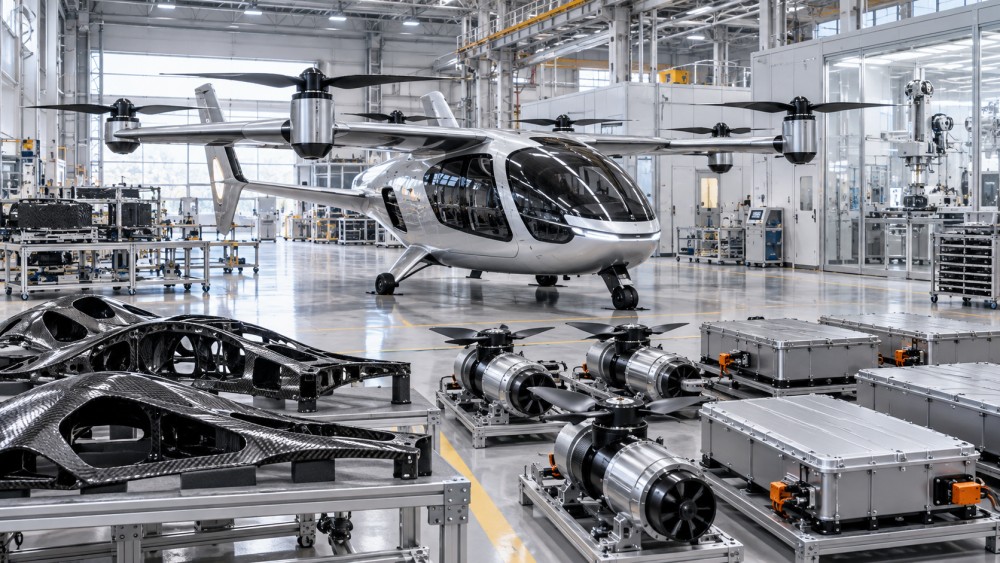
What procurement opportunities does UAM create for component suppliers? The largest near-term opportunities sit in subsystems that directly determine aircraft safety, payload, energy use, and dispatch reliability.
Unlike conventional aerospace programs, UAM developers are frequently pursuing compressed development timelines while building production systems before commercial operations begin.
This creates demand for suppliers able to provide engineering support, prototype responsiveness, qualification evidence, and a credible path toward repeatable series manufacturing.
Early procurement demand commonly concentrates on airframe structures, electric propulsion hardware, power electronics, avionics integration, flight controls, landing systems, and thermal protection.
Each category carries different entry barriers. Some require deep material science, while others reward software assurance capability, precision manufacturing, or high-rate assembly expertise.
Suppliers should avoid treating UAM as simply a smaller version of commercial aviation. Aircraft architectures, operating cycles, maintenance assumptions, and buyer priorities can differ significantly.
Many eVTOL programs need components optimized for frequent takeoffs, short route cycles, urban noise constraints, distributed propulsion, and simplified maintenance access.
Procurement decisions therefore emphasize system compatibility. A technically capable component may still lose if it introduces integration complexity, excess weight, supply risk, or certification uncertainty.
Lightweight Airframes Create Demand Beyond Composite Parts
Weight reduction remains one of the clearest procurement opportunities because every kilogram affects battery requirements, payload capability, hover performance, range, and operating margins.
UAM manufacturers are sourcing carbon-fiber composite fuselage sections, thermoplastic composite components, lightweight aluminum alloys, titanium fasteners, bonded assemblies, and high-performance structural adhesives.
Composite suppliers can add value by providing more than raw material. They should offer design allowables, cure-cycle expertise, repair procedures, inspection methods, and manufacturing repeatability data.
Wing box assemblies, rotor support structures, cabin frames, battery enclosures, and crashworthy passenger cells require precise structural analysis and robust production control.
There is particular demand for hybrid structures combining composites with titanium, aluminum, or steel interfaces. These interfaces often become critical points for fatigue, corrosion, and load transfer.
Suppliers of titanium fasteners and specialty joining systems can benefit where conventional hardware adds unnecessary mass or complicates composite assembly processes.
Procurement teams will favor suppliers that can demonstrate stable material sourcing, lot traceability, nondestructive inspection capability, and configuration control across engineering and production changes.
For smaller companies, a practical entry point may be supplying qualified subassemblies rather than competing immediately for an entire fuselage or primary structural package.
Electric Propulsion Expands Materials and Precision Manufacturing Needs
Distributed electric propulsion creates procurement demand across motors, rotors, inverters, gearboxes, housings, bearings, thermal interfaces, wiring systems, and vibration-resistant fasteners.
Although eVTOL aircraft do not rely on conventional turbofan engines, aerospace propulsion experience remains highly relevant in rotating hardware, containment design, fatigue analysis, and lightweight materials.
Suppliers with expertise in hollow titanium blades, composite blade construction, blade containment, and high-speed rotating assemblies can adapt capabilities to advanced rotor systems.
Rotor and propeller suppliers must increasingly support low-noise operation. Urban acceptance depends on acoustic performance, making blade geometry, surface quality, and balance control procurement priorities.
Motor housings and inverter enclosures require low mass, electromagnetic compatibility, thermal conductivity, and resistance to vibration, humidity, salt exposure, and repeated temperature cycling.
Precision manufacturers can pursue opportunities in shafts, bearings, cooling plates, stator laminations, magnetic retention features, and specialized sealing components for electric propulsion modules.
Buyers will examine not only efficiency data but also failure containment, maintainability, inspection intervals, and whether a supplier can sustain consistent quality at higher production volumes.
Suppliers should prepare evidence packages that connect material selection and manufacturing methods to expected duty cycles, environmental exposure, fault conditions, and retirement criteria.
Battery Safety and Thermal Management Are Strategic Supply Categories
Battery systems are often the most commercially sensitive UAM subsystem because they influence aircraft range, charging turnaround, payload economics, fire safety, and fleet availability.
This creates procurement opportunities for cell manufacturers, battery pack integrators, thermal-management specialists, fire-resistant materials suppliers, and sensor providers supporting battery health monitoring.
Aircraft developers need lightweight enclosures that resist impact, isolate thermal events, manage venting, and protect surrounding structures from smoke, heat, and electrical faults.
Suppliers of phase-change materials, thermal interface materials, cooling plates, ceramic barriers, flame-resistant composites, and high-voltage connectors can address these requirements directly.
The qualification burden is substantial. Aviation buyers need reliable behavior under vibration, altitude, shock, electromagnetic interference, rapid charging, and abnormal thermal conditions.
Procurement opportunities are strongest for suppliers that understand both battery chemistry and aircraft integration, rather than offering industrial products with limited aerospace validation.
Battery suppliers also need transparent capacity planning. UAM operators may require replacement packs, spares, repair support, data services, and safe end-of-life handling.
A credible commercial proposal should show total lifecycle value, including energy efficiency, maintenance needs, diagnostic capability, warranty assumptions, and compliance with emerging transport regulations.
Avionics and Flight Controls Offer High-Value, Long-Term Positions
UAM aircraft depend on sophisticated avionics because they must operate safely in dense airspace, often with high levels of automation and limited pilot workload.
Procurement opportunities include fly-by-wire computers, flight management systems, glass cockpit displays, navigation sensors, communication systems, power distribution units, and redundant data networks.
Suppliers with software assurance expertise can become especially valuable because safety-critical avionics require rigorous development, verification, configuration management, and cybersecurity practices.
Buyers are seeking modular avionics architectures that can evolve as airspace rules, autonomy capabilities, communication standards, and operational concepts become clearer.
Flight control procurement is not limited to computers. It includes actuators, position sensors, control-surface mechanisms, wiring harnesses, hydraulic alternatives, and fault-monitoring systems.
For suppliers, the opportunity lies in reducing integration risk. Components with defined interfaces, tested redundancy strategies, and clear certification artifacts are easier for aircraft developers to adopt.
Avionics companies should expect long qualification cycles, but successful programs can create recurring revenue through upgrades, software support, repairs, fleet analytics, and aftermarket service.
Suppliers should also consider ground-side integration, including fleet operations software, charging coordination, health monitoring, vertiport communications, and maintenance data exchange.
Landing Gear and Actuation Must Support Frequent Urban Cycles
UAM aircraft may face substantially different landing patterns from traditional aircraft, with frequent short missions, high utilization targets, and repetitive ground handling at constrained sites.
Landing gear procurement therefore focuses on durability, low weight, compact packaging, corrosion protection, impact absorption, and inspection simplicity rather than conventional design assumptions alone.
Suppliers of high-strength steel, titanium forgings, shock absorbers, braking components, wheel assemblies, and actuation hydraulics can find specialized roles in this market.
Some eVTOL concepts use fixed gear to reduce complexity, while others require retractable systems to improve aerodynamic efficiency. Both configurations require reliable actuation and structural interfaces.
Precision actuation suppliers can support door mechanisms, tilt-rotor systems, landing gear deployment, control surfaces, cooling shutters, and emergency release functions.
Equipment must withstand contamination, rain, dust, temperature changes, and frequent loading cycles while remaining easy for operators to inspect between missions.
Suppliers should demonstrate fatigue performance through representative testing rather than relying only on legacy aerospace data from unrelated duty profiles or operating environments.
Aftermarket readiness matters here. Easily replaceable wear parts, condition monitoring, repair manuals, and spare-part availability can materially improve a supplier's procurement attractiveness.
Certification Readiness Often Decides Supplier Selection
UAM developers are under pressure to achieve airworthiness approval, so suppliers that reduce certification uncertainty often gain an advantage over lower-cost but less-prepared competitors.
Component procurement increasingly includes evaluation of quality systems, design assurance, material traceability, test evidence, special-process approvals, and supplier-change notification procedures.
For safety-critical hardware, buyers may expect alignment with aviation standards covering environmental testing, software assurance, hardware assurance, and production quality management.
Suppliers should identify which certification responsibilities belong to the aircraft manufacturer, the system integrator, and the component provider before committing engineering resources.
A useful commercial strategy is to provide a compliance roadmap with the quotation. This demonstrates understanding of testing, documentation, qualification gates, and program timing.
Smaller suppliers can compete effectively when they bring focused technical expertise and cooperate with established aerospace integrators for system certification and production support.
However, suppliers should not assume prototype acceptance guarantees production business. Buyers will reassess suppliers when aircraft designs stabilize and production rates begin to rise.
The strongest position combines early design participation with disciplined industrialization, including process capability, second-source planning, quality escape prevention, and transparent corrective-action systems.
How Suppliers Should Evaluate the Commercial Opportunity
Not every UAM program offers the same procurement potential. Suppliers should assess the maturity of the aircraft developer, funding position, certification strategy, manufacturing plan, and operator relationships.
A credible customer should have a defined aircraft configuration, realistic route assumptions, a test program, a supply-chain governance model, and clear responsibility for system integration.
Suppliers should calculate the opportunity using expected aircraft volumes, shipset value, aftermarket demand, development investment, qualification cost, payment terms, and likely program duration.
Development contracts can consume engineering capacity without generating sustainable returns. Milestone payments, tooling ownership, intellectual-property terms, and change-control mechanisms require close attention.
Portfolio fit is also important. A supplier entering UAM should look for technology reuse across cargo drones, special-purpose aircraft, regional electric aviation, and conventional aerospace programs.
Manufacturing scalability deserves equal scrutiny. A component designed for ten demonstrators may become difficult or expensive to build consistently for hundreds of production aircraft.
Suppliers should invest in automation, digital traceability, supplier development, and capacity modeling only when supported by credible demand signals and contractual visibility.
In many cases, the best opportunity is a carefully selected subsystem where the supplier can own meaningful engineering value rather than supplying a low-margin commodity part.
Building a Procurement Position in the UAM Supply Chain
Suppliers pursuing UAM business should begin by mapping their capabilities against aircraft-level requirements: weight, energy efficiency, redundancy, environmental durability, manufacturability, and certification evidence.
They should then identify which developers need their technology now, which requirements remain unstable, and where early collaboration can influence the eventual production specification.
Technical sales teams need to speak the language of total aircraft value. Weight saved, maintenance hours reduced, fault detection improved, and qualification risk avoided are measurable advantages.
Partnerships can accelerate market entry. Material specialists, electronics manufacturers, machining companies, and avionics developers may jointly offer integrated solutions that reduce buyer coordination burdens.
Suppliers should also develop an aftermarket proposition before aircraft enter service. UAM operators will need repair capability, fleet spares, digital diagnostics, training, and responsive logistics.
The market remains uneven, and timelines will vary by region and aircraft category. That uncertainty makes disciplined customer selection more important than broad, speculative investment.
Nevertheless, the procurement foundation is being established now. Suppliers that engage during design and qualification can influence standards, interfaces, and long-term sourcing relationships.
Urban Air Mobility will reward suppliers that treat the sector as a demanding aerospace market with new operational constraints, not as an experimental technology segment alone.
Conclusion
UAM creates meaningful procurement opportunities for suppliers of lightweight structures, propulsion hardware, battery-safety systems, avionics, flight controls, landing gear, and precision actuation technologies.
The best opportunities go to suppliers that connect technical performance with airworthiness readiness, scalable production, lifecycle support, and a clear understanding of operator economics.
For companies evaluating what procurement opportunities UAM creates for component suppliers, the practical answer is to target critical subsystems where proven capability solves a measurable aircraft constraint.
Early participation matters, but long-term value depends on qualification discipline, supply resilience, and the ability to support manufacturers as prototype programs become certified commercial fleets.
- avionics integration
- urban air mobility
- eVTOL aircraft
- composite fuselage
- titanium fasteners
- hollow titanium blades
- blade containment
- actuation hydraulics
- shock absorbers
- glass cockpit displays
- flight management systems
- cargo drones
- composite fuselage sections
- What procurement opportunities does UAM create for component suppliers?